Wednesday, May 28, 2025

Heat class 7 SDI


Date : May 26,2025                             HEAT                           Class work

Presentation

Sea breeze and land breeze


Concept 1 “ Hot and Cold”


Hot: Degree of measurement of having a high temperature than surroundings

Cold:  Degree of measurement of having a low temperature than surroundings

Concept 2 “ Measuring temperature”

Celsius scale:- A type of Scale use to measure temperature .

Temperature:- A reliable measure of the hotness of object is called temperature of that object.

Thermometer:- Device used to measure temperature is called thermometer.

It is of two types:-

Clinical thermometer

Laboratory thermometer

Question: State similarities and differences between the laboratory thermometer and the clinical thermometer.
Ans. Similarities:
(i) Both thermometers consist of long narrow uniform glass tubes.
(ii) Both have a bulb at one end.
(iii) Both contain mercury in bulb.
(iv) Both use Celsius scale on the glass tube.
Differences:
(i) A clinical thermometer reads temperature 35°C to 42°C while the range of laboratory thermometer is -10°C to 110°C.
(ii) Clinical thermometer has a kink near the bulb while there is no kink in the laboratory thermometer.
Due to kink mercury does not fall down on its own in clinical thermometer.

Question :In a mercury thermometer, the level of mercury rises when its bulb comes in contact with a hot object. What is the reason for this rise in the level of mercury?

Solution:It is a property of mercury to expand when heated. Hence, after expansion it rises in the capillary tube.

Question : For setting curd, a small amount of curd is added to warm milk. The microbes present in the curd help in setting if the temperature of the mixture remains approximately between 35°C to 40°C. At places, where room temperature remains much below the range, setting of curd becomes difficult. Suggest a way to set curd in such a situation.
Solution:(i) In order to maintain the desired temperature of the mixture, the container can be wrapped either by woollen material or any other poor conductor of heat. Alternatively, the mixture can be kept in a heat resistant container.
(ii) The container can be kept in the sun or near the gas stove while cooking.

Question :To keep her soup warm Paheli wrapped the container in which it was kept with a woollen cloth. Can she apply the same method to keep a glass of cold drink cool? Give reason for your answer.
Solution:
Yes, she can apply the same method to keep a glass of cold drink cool because wool is a poor conductor of heat.

Question : You may have noticed that a few sharp jerks are given to clinical thermometer before using it. Why is it done so?
Solution:
A clinical thermometer has a kink which prevents immediate backflow of the mercury from the tube to the bulb, thus allowing us to read the temperature conveniently. This is the reason why we give a jerk to the thermometer before taking a new reading. The jerk positions the mercury below 35 degree .

Question: Why is it advised not to hold the thermometer by its bulb while reading it?
Solution:
It is advised not to hold the thermometer by its bulb while reading it because on holding a thermometer by its bulb, the mercury in the bulb expands due to our body temperature and gives false reading

Concept 3 “ Transfer of heat”

Conduction:-The process by which heat is transferred from the hotter end to the colder end of an object is known as conduction.

Conductor:-The materials which allows heat to pass through them easily are called conductors.

Example:- Aluminium, Iron and copper.

Insulator:- The material which donot allow heat to pass through them easily are called insulators.

Example:- Plastic and wood.

Convection:- The process of transfer of heat by actual motion of matter is called convection.

It is possible only in fluids.

Radiation:- The transfer of heat between separated by a distance even in vaccum is called radiation. Here no medium is required.

Land breeze:- At night cool air blows from land to sea in a cyclic manner. This is called land breeze.

Sea breeze:-At day cool air blows from sea to land in a cyclic manner. This is called Sea breeze.

Question: Give two examples each of conductors and insulators of heat.
Ans. 

Conductors—aluminium, iron

Insulators—plastic, wood.

Question : A laboratory thermometer A is kept 7 cm away on the side of the flame while a similar thermometer B is kept 7 cm above the flame of a candle as shown in figure.

Which of the thermometers, A or B, will show a greater rise in temperature? Give reason for your answer.

Solution: Thermometer B will show a greater rise in temperature because hot air rises up or air on the top of the candle flame is getting heated by convection


Question :A circular metal loop is heated at point O as shown in figure.
NCERT Exemplar Class 7 Science Chapter 4 Structure of the Atom q12
(i) In which direction would heat flow in the loop?
(ii) In which order the pins at points P, Q and R fixed with the help of wax fall if points O, P, Q and R are equidistant from each other?

Solution:
(i) The heat will flow in both the directions i.e. from O to P and O to R.
(ii) At first the pins at R and P will fall simultaneously followed by the pin at Q.

Question :In the arrangements A and B shown in figure, pins P and Q are fixed to a metal loop and an iron rod with the help of wax. In which case are both the pins likely to fall at different times? Explain.
NCERT Exemplar Class 7 Science Chapter 4 Structure of the Atom q13
Solution:
In case B, the pin P will fall before the pin Q because the heat will reach pin P first. In case A, the heat travels in both the directions and pins P and Q will fall simultaneously.

Question : While constructing a house in a coastal area, in which direction should the windows preferably face and why?
Solution:
The windows of houses in coastal areas should preferably face towards the sea as sea breeze will keep it cool during day time.

Q.6. Look at figure 4.6. Mark where the heat is being transferred by conduction, by convection and by radiation
Ans.
NCERT Solutions for Class 7 Science Chapter 4 Heat Q6


Question : Observe the picture given in figure. Water is being boiled in a pan of wide base.
NCERT Exemplar Class 7 Science Chapter 4 Structure of the Atom q19
(i) Which position P or T will feel warmer?
(ii) Fill up the boxes P and T to indicate the mode of flow of heat to the hand.
Solution:
(i) Position P will feel warmer than T because when the air gets heated, it rises upwards.
(ii) P → Convection
T → Radiation

Question : Look at figure.
NCERT Exemplar Class 7 Science Chapter 4 Structure of the Atom q20
The length of wire PQ in case of A is equal to the diameter of the semicircle formed by the wire CDE, in case B. One pin is attached to each wire with the help of wax as shown in figure. Which pin will fall first? Explain.
Solution:
The pin on the wire in case A will fall first as heat will reach to it before it reaches the pin in case B (as CDE > PQ). In both the cases, heat is transferred to the pins mainly through conduction.

Concept 4 “ Kinds of clothes we wear in summer and winter”

Ques :Shopkeepers selling ice blocks usually cover them with jute sacks. Explain why.
Solution:
Shopkeepers selling ice blocks usually cover them with jute sacks because jute sack is an insulating material so it prevents ice from melting at a faster rate.

Question : At a camp site there are tents of two shades – one made with black fabric and the other with white fabric. Which one will you prefer for resting on a hot summer afternoon? Give reason for your choice. Would you like to prefer the same tent during winter?
Solution:(
i) On a hot summer afternoon, the tent made up of white fabric will be preferred as white colour is a bad absorber and good reflector of heat.
(ii) No, the black fabric tent will be preferred during winter.

Question : Discuss why wearing more layers of clothing during winter keeps us warmer than wearing just one thick piece of clothing?
Ans:
More layers of clothing keep us warm in winters as they have a lot of space between them. This space gets filled up with air. Air is a bad conductor, it does not allow the body heat to escape out.

Question: In places of hot climate it is advised that the outer walls of houses be painted white. Explain.
Ans:
In places of hot climate it is advised that the outer wall of houses be painted white because white colour reflects heat and the houses do not heat up too much .

Back exercise

Q.3.Fill in the blanks
The hotness of an object is detetmined by its ____________ .
(b) Temperature of boiling water cannot be measured by a ____________ thermometer.
(c) Temperature is measured in degree ____________ .
(d) No medium is required for transfer of heat by the process of ____________.
(e) A cold steel spoon is dipped in a cup of hot milk. It transfers heat to its other end by the process of ____________
(f) Clothes of ___________ colours absorb heat better than clothes of light colours.

Ans. (a) temperature (b) clinical (c) Celsius (d) radiation (e) conduction (f) dark

NCERT Solutions for Class 7 Science Chapter 4 Heat Q4Q.8. One litre of water at 30°C is mixed with one litre of water at 50°C. The temperature of the mixture will be:
(a) 80°C (b) More than 50°C but less than 80°C
(c) 20°C (d) Between 30°C and 50°C
Ans.(d) Between 30°C and 50°C.

Q.9. An iron ball at 40°C is dropped in a mug containing water at 40°C. The heat will:
(a) flow from iron ball to water.
(b) not flow from iron ball to water or from water to iron ball.
(c) flow from water to iron ball.
(d) increase the temperature of both.
Ans. (b) not flow from iron ball to water or from water to iron ball

Q.10. A wooden spoon is dipped in a cup of ice-cream. Its other end:
(a) becomes cold by the process of conduction
(b) becomes cold by the process of convection
(c) becomes cold by the process of radiation
(d) does not become cold
Ans.(d) does not become cold.

Q.11.Stainless steel pans are usually provided with copper bottoms. The reason for this could be that:
(a) copper bottom makes the pan more durable
(b) such pans appear colourful
(c) copper is a better conductor of heat than the stainless steel
(d) copper is easier to clean than the stainless steel
Ans.(c) copper is better conductor of heat than the stainless steel


Tuesday, May 13, 2025

" Nutrition in animals " class 7 ncert

                 test https://forms.gle/SX1A1GqKW2qHV1w36       

Chapter 2:-Nutrition in animals:-

Presentation


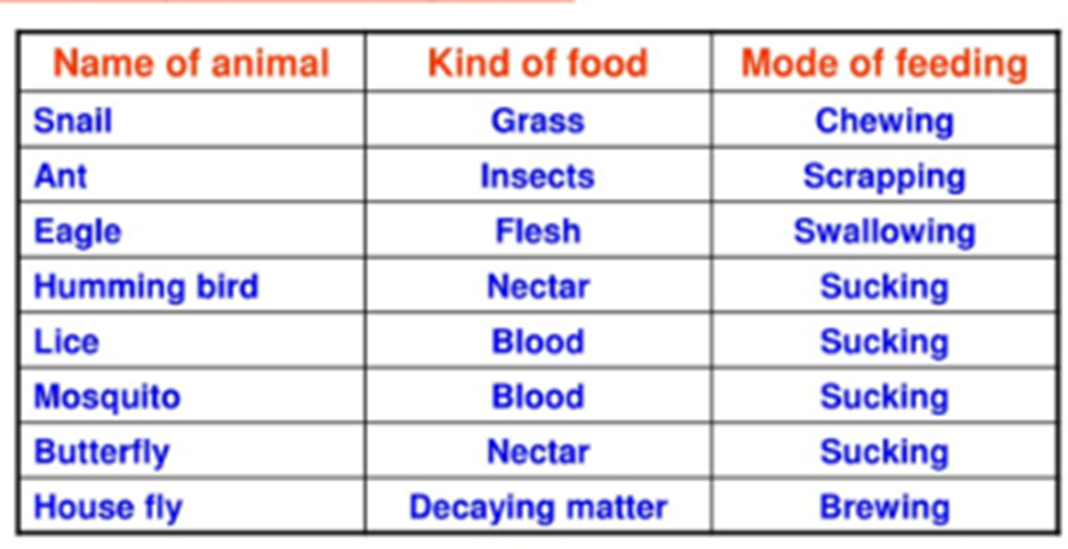
Concept 1 Different ways of taking food


Concept 2 Digestion in humans

Keywords

1.Ingestion:-The process of taking food into the body is called Ingestion.

2.Digestion:-Breakdown of complex components of food into simpler  substances is called digestion.

3.Absorption:- The process by which digested food pass into the blood vessels in the wall of intestine.

4.Assimilation:- utilisation of food by the target organ is called assimilation.

Or

Process by which absorbed substances are used to build complex substances such as proteins required by body.

5.Egestion:-The process of removal of faecal matter through anus from time to time is called Egestion

6.Buccal Cavity:-Oral cavity that contains teeth , tongue and salivary glands.

7.Milk teeth:-The first set of teeth grows during infancy and they fall off at the age of 6 to 8 years.

8.Permanent teeth:-Second set of teeth that replace milk teeth.

9.Incisor:-Teeth for cutting and biting is called incisor. They are 8 in number.

10.Canine:-Large , pointed teeth just behind the incisors that are used for piercing and tearing of food.

11.Premolar:-Teeth for grinding and chewing. They are 8 in number.

12.Molar:-Teeth for grinding and chewing is called Molar..They are 12 in number.

13.Salivary glands:- Glands which secrets saliva.

14.Saliva:- liquid which breakdown starch into simpler substances is called Saliva.

Liquid which helps to make the food soften.

15.Oesophagus:- Food pipe that run along neck and chest.

16.Liver:-Largest gland of body which secrets bile juice is called Liver.

17.Gall bladder:-A sac like structure which store bile.

18. Bile:-A yellow green fluid made by liver that store in gall bladder.

19.Pancreas:-A large cream coloured gland located just below stomach.

20.Villi:- Inner wall of small intestine have thousands of finger like outgrowth called Villi.

21.Amino acids:-Proteins  break down into simple substances or molecules called amino acids.

22.Fatty acids:-Building blocks of fat in body is called fatty acids

23.Glycerol:-A colourless sweet liquid produce by  breakdown of fat is called glycerol.

Question : What is villi ? What is their location and function ?

Answer : Villi are tiny, finger-like projections found on the inner surface of the small intestine. They are located in the small intestine and their function is to increase the surface area for nutrient absorption. This increased surface area allows for more efficient absorption of digested food into the bloodstream. 

Question: Where is bile produced? Which component of the food does it help to digest ?

Answer : Bile is produced in the liver and helps digest fats

Question : Why do we get instant energy from glucose ?

Answer : We get instant energy from glucose because it's a simple sugar that the body can readily absorb and utilize

Ques: Boojho took some grains of boiled rice in test tube ‘A’ and Paheli took boiled and chewed rice in test tube ‘B’. Both of them poured 1 – 2 drops of iodine solution into the test tube and observed the colour change. What colour change would they have observed? Give reasons for your answer.

Answer : Boojho would observe a blue-black color change in test tube A, while Paheli would observe no color change in test tube B. This is because boiled rice contains starch, which reacts with iodine to form a blue-black complex. However, in test tube B, chewing breaks down the starch into simpler sugars, which do not react with iodine

Ques : ‘A’ got her gall bladder removed surgically as she was diagnosed with stones in her gall bladder. After the surgery, she faced problems in digestion of certain food items when consumed in bulk. Can you tell which kind of food items would they be and why?

Answer : After gallbladder removal, 'A' would likely experience difficulty digesting fatty foods when consumed in large quantities. This is because the gallbladder stores and concentrates bile, which is essential for breaking down fats in the digestive system. Without the gallbladder, the bile is released continuously and may not be concentrated enough to efficiently digest large amounts of fat. 

Ques : Ruminants such as cows and buffaloes swallow their food hurriedly and then sit restfully and chew their food. Can you reason why?

Answer : Ruminants like cows and buffaloes swallow food quickly and then chew it later because their digestive system is adapted to break down tough plant matter, like grass, efficiently. They initially swallow the food into their rumen, a specialized chamber in the stomach where it is fermented by bacteria. Later, they regurgitate this partially digested food (the cud) and chew it further before swallowing it again into the rest of their digestive system

Ques : Boojho and Paheli were eating their food hurriedly so that they could go out and play during the recess. Suddenly, Boojho started coughing violently. Think of the reasons why he was coughing and discuss with your friends.

Answer : Boojho's violent coughing could be due to food entering his windpipe instead of his esophagus. Eating too quickly, talking, or laughing while eating can disrupt the swallowing mechanism, causing food to go down the wrong path. This can lead to a choking sensation and a violent cough to dislodge the foreign object. 

Concept 3 Digestion in grass eating animals

Keywords

1.Cellulose:-A type of carbohydrates digested by special bacteria present in rumens of ruminants.

2.Rumen:- Animals such as cow deer etc . quickly swallow the grass and store it in a part of stomach called rumen.

3.Ruminant:- Animals which show rumination is called Ruminant. Eg deer , cattle etc 

4.Rumination:-The process in which animals chew the cud which replaces in its mouth in small lumps is called Rumination.

Question : Name the type of carbohydrates that can be digested by ruminants but not by humans . Give the reason also.

Answer : The type of carbohydrate that ruminants can digest but humans cannot is cellulose

Concept 4 Feeding and digestion in Amoeba

Keywords

1.Amoeba:-A microscopic single celled organism found in pond water.

2.Food vacuole:-A sac like structure which trap food for storage.

3.Pseudopodia:- False feet or finger like projection seen in Amoeba to capture its prey .

Question : Write one similarity and one difference between the nutrition in amoeba and human beings.

Answer : Similarity: Both amoebas and human beings are heterotrophs, meaning they both obtain their nutrition by consuming other organisms. 

Differences :


Home Task

Q 1: Rohan observed that his pet cow was chewing continuously even when it was not eating. Why do cows do that? What does this indicate about their digestive system?

Q 2: If the salivary glands stop functioning, how will it affect the digestion of food? Explain with reasons.

Q 3: A student examined a sample of food under a microscope and saw amoebas surrounding it with pseudopodia. What process was being observed? What does it tell us about the nutrition in amoeba?

Q 4: How is the process of digestion in a ruminant animal different from that in humans? Mention any two differences.

Q 5: Amit complains of indigestion and stomach pain after eating very quickly. What habits should he change, and why?

Q 6: Draw the diagram of the human digestive system. Label the following parts:

Mouth        Stomach    Small intestine           Large intestine
Also mention the function of any one of these parts.


Q 7: Why should we not lie down immediately after eating a heavy meal? Relate your answer to the process of digestion.

Q8: Why does food take longer to digest in the stomach than in the mouth? What advantages does this provide to the body?

Q9: Explain how the nutrients absorbed in the small intestine reach different parts of the body. Which system is involved apart from the digestive system?


GRADE -7 Science HH


S. D. INTERNATIONAL SCHOOL

SUMMER HOLIDAYS HOMEWORK

GRADE -7 Science  


1.     The assignment is to be documented in the science notebook

2.      Chapters 1, 2, and 3 require careful revision to grasp the key concepts.

3.      Assignment chapter 2 “ Nutrition in animals”

Q 1: Rohan observed that his pet cow was chewing continuously even when it was not eating. Why do cows do that? What does this indicate about their digestive system?

Q 2: If the salivary glands stop functioning, how will it affect the digestion of food? Explain with reasons.

Q 3: A student examined a sample of food under a microscope and saw amoebas surrounding it with pseudopodia. What process was being observed? What does it tell us about the nutrition in amoeba?

Q 4: How is the process of digestion in a ruminant animal different from that in humans? Mention any two differences.

Q 5: Amit complains of indigestion and stomach pain after eating very quickly. What habits should he change, and why?

Q 6: Draw the diagram of the human digestive system. Label the following parts:

Mouth               Stomach            Small intestine               Large intestine
Also mention the function of any one of these parts.

Q 7: Why should we not lie down immediately after eating a heavy meal? Relate your answer to the process of digestion.

Q8: Why does food take longer to digest in the stomach than in the mouth? What advantages does this provide to the body?

Q9: Explain how the nutrients absorbed in the small intestine reach different parts of the body. Which system is involved apart from the digestive system?

 High Order Thinking Skill Assignment :

Chapter 1 Nutrition in Plants –

1.      Imagine a plant placed in a sealed transparent container with ample sunlight but no carbon dioxide. Predict and explain what will happen to the plant over a week.

  1. If you were a Rhizobium bacterium living in the root nodules of a leguminous plant, describe your daily activities and how you benefit the plant.
  2. Propose an experiment to demonstrate that chlorophyll is essential for photosynthesis. What controls would you include?
  3. Compare and contrast the modes of nutrition in a pitcher plant and a mushroom. How do their nutritional strategies adapt them to their environments?
  4. Why are farmers advised to grow leguminous crops in rotation with other crops? Discuss the underlying biological processes involved.
  5. Imagine you're a detective investigating a case where a plant isn't thriving despite adequate sunlight and water. What could be the possible reasons? Consider factors like chlorophyll presence, carbon dioxide levels, and nutrient availability.
  6. Suppose scientists discover a new planet species on Mars that doesn't perform photosynthesis but thrives in low-light conditions. How might this plant obtain its nutrition? Propose a possible mode of nutrition and justify your reasoning.

8.      You're transported back to a time before plants evolved chlorophyll. How did early plant-like organisms obtain energy? Discuss the evolution of autotrophic nutrition.

  1. Write a diary entry from the perspective of a leaf detailing a day in the life of photosynthesis, including interactions with sunlight, water, and carbon dioxide.
  2. As an agricultural scientist, design a soil composition that would maximize plant growth without synthetic fertilizers. What natural components would you include, and why

Chapter 2 :Nutrition in Animals

1.      Trace the journey of a morsel of bread through the human digestive system, highlighting the role of enzymes at each stage.

  1. Describe the process of nutrition in an amoeba from the organism's point of view. How does it locate and digest its food?
  2. Explain why cows chew cud. What advantages does this behavior provide in terms of digestion and nutrient absorption?
  3. Design an activity to show the effect of saliva on starch. What observations would confirm the action of salivary amylase?
  4. Conduct an experiment to map the taste regions of the human tongue. How would you test for sweet, salty, sour, and bitter tastes?

Or

Create a map of the human tongue indicating the regions most sensitive to different tastes. How does this distribution aid in nutrition and survival?


  1. If you were to design a digestive system for a new species that consumes both plants and animals, what features would it have? Explain the reasoning behind the length of the intestine, types of teeth, and enzymes present.
  2. Narrate a short story from the perspective of an amoeba hunting for food, capturing it, and digesting it. Highlight the processes involved in its nutrition.
  3. Imagine you're a cow explaining to a non-ruminant friend why you chew cud. Describe the benefits of this process in your own words.
  4. Design an experiment to test the effect of temperature on the activity of salivary amylase. What results would you expect, and why?